Trump says Iran war "close to over" amid hopes for more negotiations
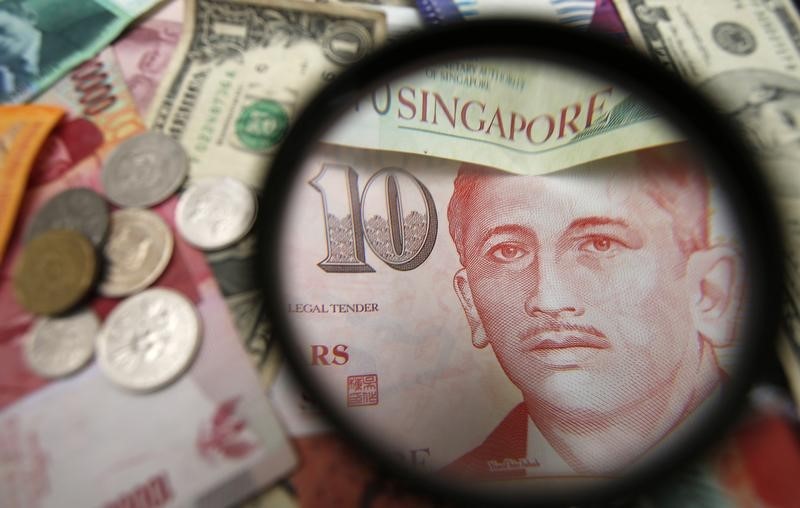
Investing.com -- The Singapore dollar (SGD) has been displaying characteristics similar to the Swiss franc (CHF), according to BofA Securities.
The brokerage describes this convergence as the “Swissification” of the SGD, a reflection of how the currency has grown more defensive and stable during global risk-off periods.
Although separated by geography and scale, Switzerland and Singapore share several core traits that underpin the behavior of their currencies.
Both hold AAA sovereign credit ratings, large net international investment positions (NIIP), and are recognized global financial hubs.
Neither country actively seeks reserve currency status, and Singapore maintains a policy of non-internationalization to preserve its monetary framework.
The correlation between USD/SGD and USD/CHF has risen steadily over the past 25 years. BofA’s analysis shows that speculative futures positioning in CHF closely tracks movements in USD/SGD, suggesting that global investor behavior now affects both currencies in similar ways.
The increase in hedge fund and proprietary trading activity in SGD has also contributed to this pattern, though these flows remain smaller than institutional and trade-related transactions.
In terms of risk-adjusted performance, SGD has remained close to CHF. Since 2020, the average three-month Sharpe ratio for being long SGD versus USD was 24 basis points, compared with 9 basis points for CHF.
Over the longer term, SGD’s higher yield and lower volatility, due to the Monetary Authority of Singapore’s (MAS) trade-weighted exchange rate band system, have supported its performance.
Both currencies now show comparable behavior in periods of financial stress. During past crises such as the global financial crisis and the early stages of the COVID-19 shock, SGD typically weakened.
But more recent data show that it increasingly appreciates or stabilizes in risk-off environments, with USD/SGD risk-reversal pricing now aligning more closely with USD/CHF.
Despite these similarities, BofA notes key differences. Singapore does not aim for reserve currency status, and MAS officials have reiterated that position. Singapore’s financial system, while large, lacks the depth of Switzerland’s markets.
Switzerland’s equity market capitalization is about three times larger than Singapore’s, and its government bond market is roughly double in size.
Moreover, nearly half of Singapore’s government securities are non-marketable and issued to meet domestic pension needs.
Still, Singapore’s role as a financial hub is evident. As of end-2024, assets under management reached around SGD6 trillion, with 77% sourced from overseas and 88% invested abroad.
The city-state has also seen rapid growth in family offices, numbering more than 2,000, ranking it second globally in competitiveness.
Its NIIP remains above 100% of GDP, providing a strong external buffer and the capacity to repatriate funds in times of global stress, as during the COVID-19 period.
In nominal terms, the CHF reached a record high against the SGD in 2025. But in real terms, the SGD’s purchasing power relative to the franc has held steady, remaining near its 26-year average.
The real effective exchange rate (REER) of the Singapore dollar has appreciated 33% over that period, outpacing the Swiss franc’s 20% rise.
Singapore’s external balance sheet and policy credibility have also reduced the volatility of capital flows.
During the 2008-09 financial crisis, portfolio outflows reached nearly 40% of GDP, but no such reversals were observed during the COVID-19 shock.
The data show that Singapore’s portfolio flows have become less tied to global risk cycles, and in some cases, counter-cyclical.
BofA adds that Singapore’s disciplined policy framework, large foreign asset base, and steady external position have enhanced its currency’s defensive characteristics.